System comparison
Epoxy or polyaspartic for a garage floor?
Neither chemistry wins every category. The useful question is where each one belongs in the complete floor system.
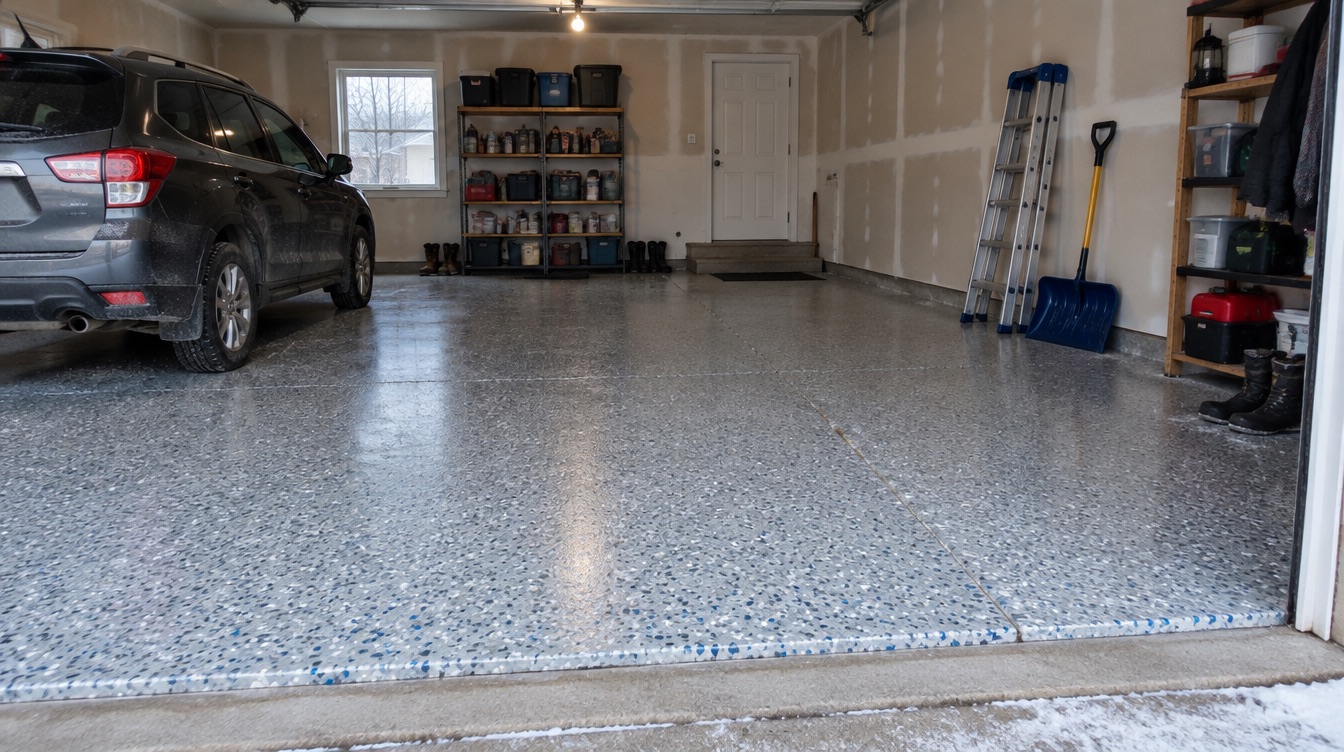
The short answer
Epoxy usually offers longer working time and can build a strong, high-solids base over properly prepared concrete. Polyaspartic products can cure much faster and are often selected for ultraviolet-stable topcoats and short closures. In a Midwest garage, a hybrid system may use an epoxy or other compatible base for build and a polyaspartic topcoat for faster return and better color stability. Product data, slab temperature, installer working time, moisture condition and the actual closure determine the better choice. Choosing only by chemistry name oversimplifies the floor.
Where the systems differ in real use
Working time during installation
Epoxy commonly gives the crew more time to place material and broadcast flakes. Fast polyaspartic chemistry demands tighter control of mixing, temperature and crew pace.
Return to service
Many polyaspartic products reach foot and vehicle milestones sooner, which can matter when the garage cannot stay empty for several days.
Ultraviolet stability
Polyaspartic topcoats are often chosen where sunlight reaches the door area. Standard epoxy can amber or chalk unless protected by a suitable finish layer.
Build and leveling
Epoxy can provide useful body and working time over prepared concrete. Exact thickness and leveling behavior depend on the named product and installation method.
Moisture compatibility
Neither label automatically solves vapor pressure. The primer or base must be approved for measured slab conditions, or a different moisture strategy is needed.
Temperature window
Cold or hot concrete changes flow, cure and working time. Product limits must match the season and the conditioned state of the garage.
Repair and maintenance
Future recoating depends on cleaning, abrasion and compatibility with the existing topcoat. A written system should name the layers so later work is not guesswork.
Why the product name is not the whole answer
A finished floor is not one liquid layer. It is a system made from the concrete surface, repairs, primer or base coat, optional broadcast media, and a protective topcoat. The name on the bucket matters less than whether those layers suit the slab and the way the room is used. A careful recommendation therefore starts with what is under the coating, what will travel across it, what can spill on it, and how long the area can stay out of service.
That is also why two rooms of the same size can need different work. One may be clean, dry and mechanically sound. The other may contain oil, weak concrete, an old sealer, damp cracks or joints that move. The visible finish can look similar on installation day while the preparation, repair scope and long-term result are very different.
Many decorative garage floors combine chemistries because the layer bonded to concrete and the layer exposed to sunlight do different jobs. A proposal that says only “poly floor” or “epoxy system” leaves out the information needed to compare performance.
The overnight deadline changes the recommendation
One homeowner can park outside for several days and wants a forgiving installation window in a climate-controlled garage. Another lives on a busy street, cannot leave vehicles outside overnight and has direct afternoon sun across the doorway. Those two schedules may justify different layer choices even when the slabs look alike.
The second project may benefit from faster-cure layers and a UV-stable topcoat, but speed does not eliminate preparation or repair time. Grinding, crack treatment, edge work and broadcast still have to be completed correctly. A “one-day” description should therefore identify what is installed that day and when vehicles may actually return.
The first project may prioritize working time, build and a slower cure. Neither homeowner is buying a chemistry contest. Each is choosing a system around access, concrete condition and exposure.
What a responsible site review checks
The existing surface
Confirm whether the slab is bare, sealed, painted, weak or contaminated. The review should distinguish a coating problem from weak or contaminated concrete because covering either one without correcting it simply hides the risk.
Water and moisture
Investigate recurring dampness and compare any test results with the exact primer limit. A floor can look dry during a short visit, so visible appearance alone is not a moisture test.
Traffic and exposure
Map sunlight, hot-tire paths, salt entry and work areas. The heaviest route or harshest cleaning method often controls the system even when most of the room has lighter use.
Edges, joints and drains
Review expansion joints, control joints, wall edges and the overhead-door termination. These transitions deserve their own scope because they are common places for water entry, impact and early wear.
The actual closure window
State the available installation window and separate foot, belongings and vehicle return. Installation time and full return to service are separate milestones.
How to compare proposals without guessing
A useful proposal identifies the named system, preparation method, repair assumptions, number or purpose of layers, finish texture, cure milestones and exclusions. It should separate “ready for foot traffic” from “ready for vehicles, hot water or chemicals.” If a statement is important to the buying decision, ask for it in the written scope rather than relying on a general product label.
Photos help with early planning, but they do not prove bond strength, contamination or moisture condition. A wide view explains access and layout; close views show cracks, drains, peeling and edge details. Final system selection still depends on a site review and, when the exposure requires it, testing against the selected product limits.
What chemistry is in each layer?
Ask for the primer or base, broadcast layer and topcoat rather than accepting one broad system name.
Why does this cure schedule fit the garage?
The answer should account for slab temperature, weather, ventilation and the time before each type of traffic returns.
How is sunlight handled?
Ask whether the exposed finish is UV stable and what color change or gloss change is considered normal.
Real questions, direct answers
Is polyaspartic always better than epoxy?
No. It often offers faster cure and strong UV stability, while epoxy can offer useful working time and build. The right layer depends on the job it must do.
Is polyaspartic the same as polyurea?
The terms are sometimes used loosely in sales material. Ask for the exact product data and layer schedule rather than relying on a shortened label.
Which system handles hot tires better?
Hot-tire resistance depends on bond, product selection, cure and the complete assembly. Mechanical preparation is essential for either chemistry.
Which one is safer around sunlight?
Many polyaspartic topcoats are selected for ultraviolet stability. Standard epoxy can change color, so the exposed top layer should be identified.
Can a garage use epoxy and polyaspartic together?
Yes, compatible hybrid systems are common. One layer can provide build and working time while another provides faster cure or color stability.
Start with the floor you actually have
Share the room type, approximate area, ZIP code, current floor condition and the deadline that matters. Photos or a share link are useful but optional.