Primary service area
Epoxy floor coatings in Chicago and Cook County
Chicago floors come with history: old slabs without vapor barriers, layers of tile and mastic, freight elevators, and neighbors upstairs. Getting the floor right starts with getting those conditions on the table.
- Coverage
- City of Chicago and suburban Cook County
- Common work
- Restaurant kitchens, auto shops, condo garages, warehouses, retail, clinics
- Edge ZIP codes
- Split with DuPage, Will, Lake or Kane: reviewed case by case
Building conditions we plan for
Older slabs on grade
Many older Chicago buildings were poured without a vapor retarder under the slab. Moisture testing is not optional on these floors; it decides whether a moisture-mitigating primer or a different system is needed.
Old tile and black mastic
Floor tile and adhesives in older buildings can contain asbestos. Before any grinding, suspect materials need testing by a qualified firm, and abatement, if required, is done by licensed contractors before coating work starts.
Access and staging
Loading zones, alley access, freight elevator bookings and parking for equipment are confirmed before the schedule is set. In high-rises, building management usually sets work hours.
Occupied, mixed-use buildings
Odor and noise matter when there are residents or tenants above. Lower-odor products and shorter cure windows can be part of the system choice.
Typical Chicago and Cook County projects
| Facility | Usual starting point | Main concern |
|---|---|---|
| Restaurant kitchens | Urethane cement with cove base | Short closures, inspection, hot water washdown |
| Condo and HOA garages | Epoxy or polyaspartic with slip texture | Road salt, drainage, resident access during work |
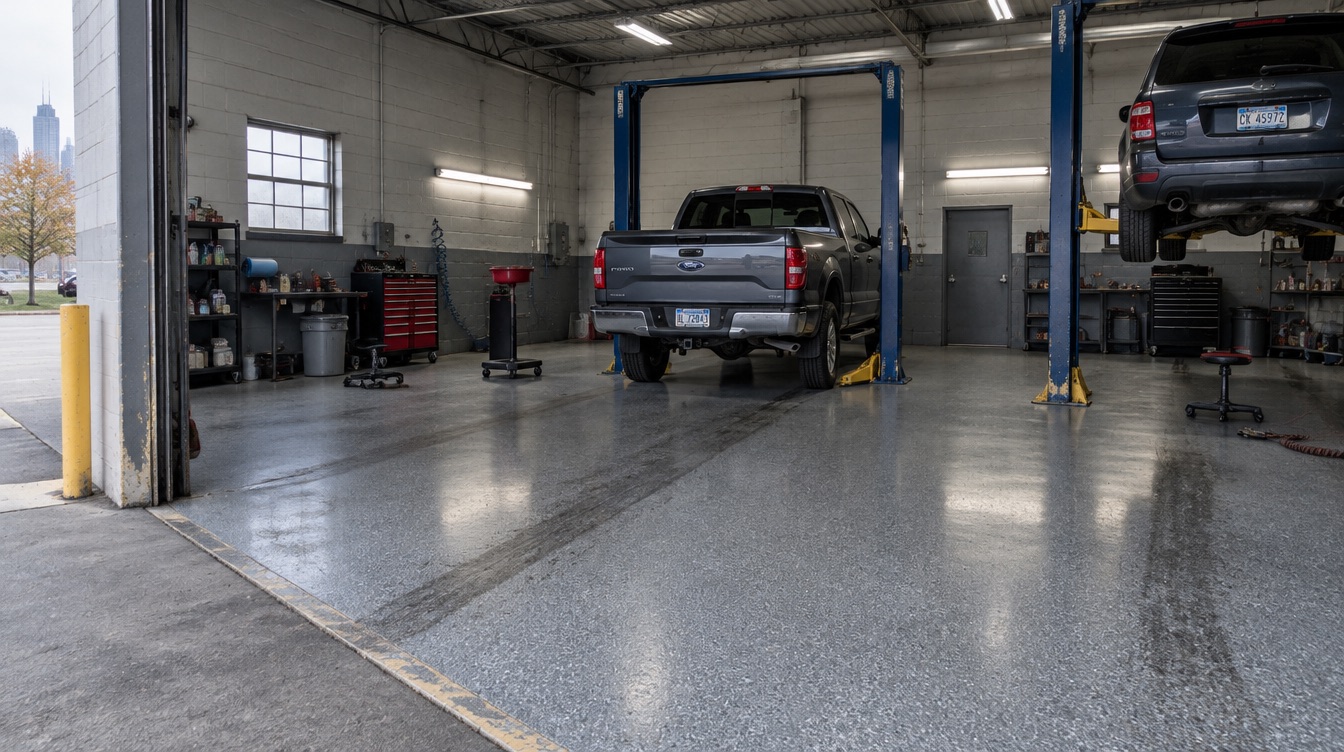
| Auto shops | Broadcast epoxy with chemical-resistant topcoat | Hot tire pickup, fluids, lift anchors |
| Suburban industrial parks | Industrial and warehouse systems | Forklift joints, chemical areas, phased closures |
| Retail and showrooms | Clear-coated or metallic finishes | Appearance, UV near storefront glass |
Suburban Cook County has large concentrations of light industrial and distribution buildings, including the business parks around Elk Grove Village, Franklin Park and Bedford Park. Those projects look more like the Northwest Indiana work than like a city restaurant.
Winter work in Cook County
Coatings have minimum temperatures for the slab and the air, and the slab must stay above the dew point, usually by at least 5°F, during application and cure. In winter that often means temporary heat, especially in garages and warehouses with open docks. Road salt brought in on tires also has to be cleaned out of the concrete before coating, not just swept.
Where Cook County coverage ends
ZIP codes with at least 60 percent of their land area in Cook County are served. ZIP codes split with DuPage, Will, Lake, Kane or McHenry counties, such as parts of Barrington, Bartlett, Hanover Park and Tinley Park, are reviewed case by case. Addresses in neighboring counties can still send a request through the form; it will tell you which group your ZIP code falls in.
Questions people ask about this area
Can you work in an occupied Chicago building?
Often, with a plan for freight elevators, dust control, ventilation, neighbor access and cure time. Those constraints are discussed before a system is promised.
What is different about older Chicago concrete?
Older slabs may have no vapor barrier and can hide mastic, patches or previous coatings. Testing and removal usually matter more than the finish color.
Do suburban Cook County projects use the same systems?
The chemistry may be the same, but access and exposure differ. A Bedford Park warehouse, a city restaurant and a suburban garage need different preparation and scheduling.
Tell us about the floor
The quote form takes a few minutes. It asks for the ZIP code, floor area and current condition. Add photos, paste a share link or send visuals later—it is your choice.