Residential kitchen floors
Epoxy flooring for home kitchens
A seamless kitchen floor can be striking and simple to clean, but it is not the right answer for every home. We look at the concrete, adjoining rooms, sunlight, comfort and how your household actually uses the kitchen.
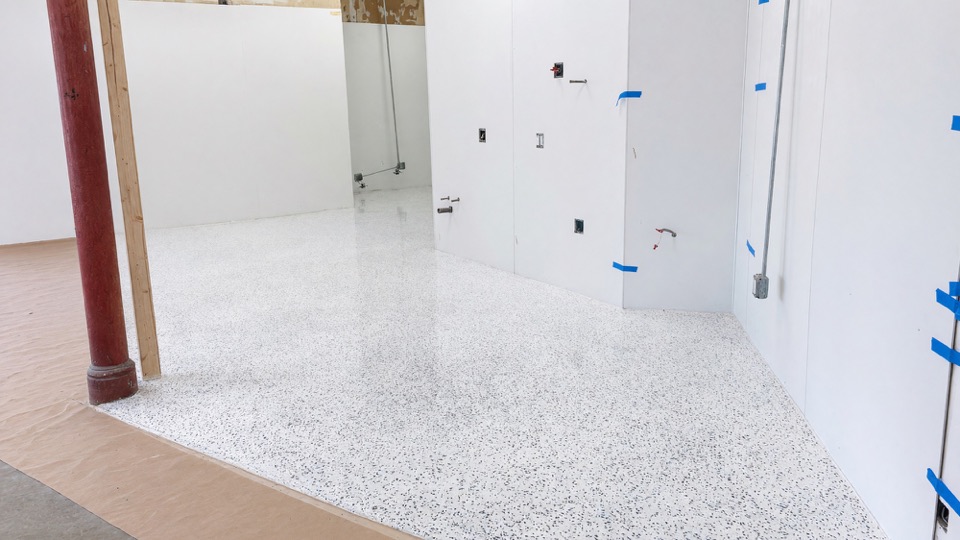
- Best fit
- Concrete kitchens, open-plan lower levels, mudrooms and adjacent utility areas
- Common finish
- Satin or low-gloss decorative system with a cleanable light texture
- First question
- Is the kitchen on a sound concrete slab
When epoxy makes sense in a home kitchen
The kitchen is already on concrete
Epoxy bonds to prepared concrete. Installing it over wood framing, flexible underlayment or unknown tile assemblies requires a different design and may not be practical.
You want one continuous surface
Open kitchens connected to a mudroom, pantry or lower-level living space can use one seamless finish without grout joints.
You accept a hard floor
Coatings are durable and easy to wipe, but they do not add the warmth or resilience of cork, wood or cushioned vinyl. Mats often belong at the sink and prep counter.
The details homeowners notice later
| Decision | Why it matters | Practical direction |
|---|---|---|
| Gloss level | High gloss shows crumbs, scratches and window reflections | Satin is usually easier to live with |
| Texture | Smooth floors become slick with water or oil | Use modest texture that still mops clean |
| Color | Very light floors show dark debris; very dark floors show dust | Choose a mid-light blend and view a physical sample |
| Transitions | Adjacent wood or tile may sit at a different height | Measure and plan reducers before coating |
| Sunlight | Standard epoxy can amber near windows and patio doors | Use a UV-stable clear topcoat |
Living through the installation
The room must be cleared of movable appliances and personal items. Fixed cabinets normally stay, with the coating carefully terminated at toe-kicks and walls. We plan dust control, ventilation and the route between the work area and the exterior. The downtime guide explains why foot traffic, appliance movement and full cure are different milestones.
When another floor may be better
A coating may be a poor fit over a moving wood subfloor, where active moisture cannot be corrected, or when the household wants a warmer and softer surface. We would rather explain that early than force epoxy into the wrong room.
Real questions people ask
Is epoxy practical in a home kitchen?
It can be when the slab is sound and the homeowner wants a seamless, easy-clean surface. It is hard underfoot and can scratch, so it is not automatically better than tile or resilient flooring.
Will a glossy kitchen floor be slippery?
Any smooth floor can become slippery with water or cooking oil. A satin topcoat and modest texture improve grip without creating a surface that traps mop residue.
Can cabinets and appliances stay in place?
Usually fixed cabinets remain, while movable appliances must be removed. Edges, toe-kicks and transitions are planned before preparation begins.
How disruptive is the smell and cure time?
Odor and return-to-use time vary by product. We plan ventilation, isolate the work area and state when people, pets and appliances may safely return.
Related pages
Tell us about the floor
Choose “Something else,” describe the kitchen and tell us what sits under the current floor. Photos or a share link are optional.