Service
Commercial epoxy flooring
Epoxy is a family of systems, not one product. The right build for a clinic corridor is wrong for an auto bay, and both are wrong for a salted condo garage ramp. We specify by exposure first, then finish.
- Typical settings
- Retail floors, clinics, gyms, auto service bays, condo and HOA garages
- Common builds
- Primer and body coat, broadcast flake or quartz, clear topcoat
- First question
- What the floor is exposed to every day
Where commercial epoxy fits
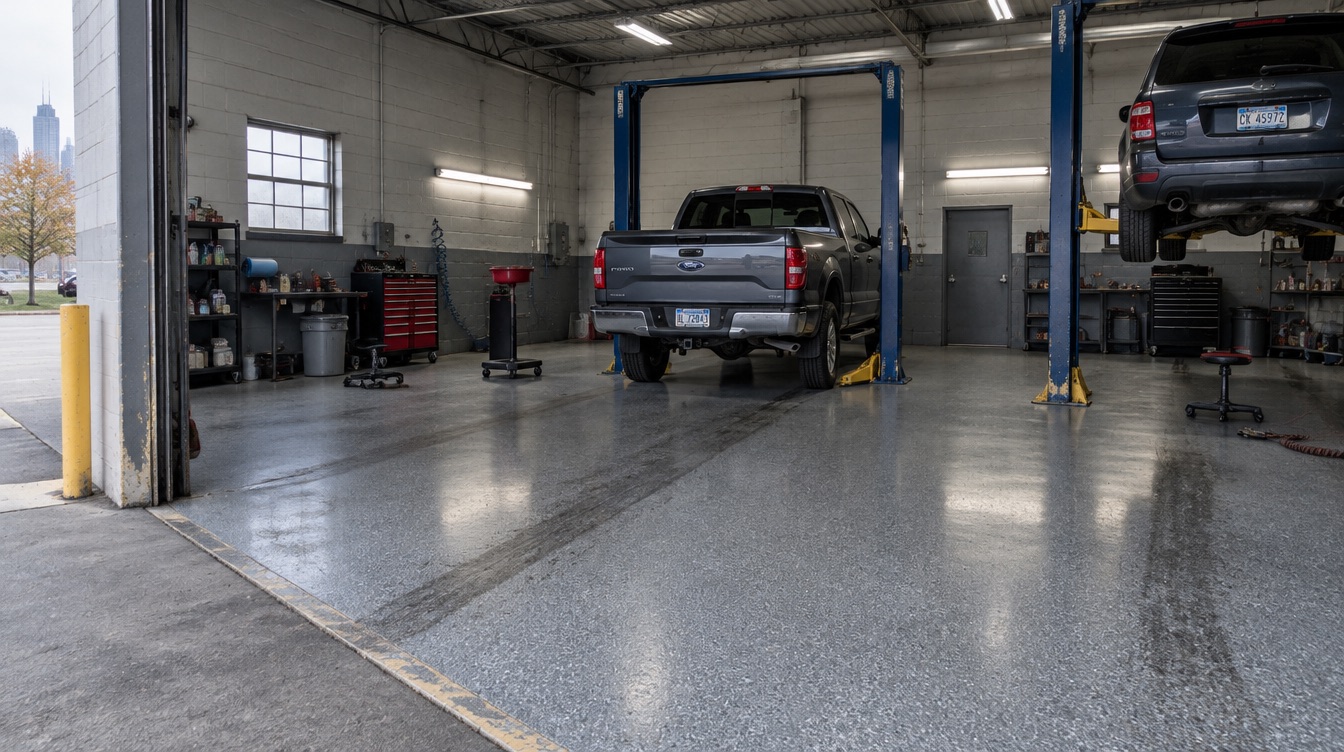
Auto shops and service bays
Hot tires, brake fluid, coolant and dropped tools. A thicker broadcast build with a chemical-resistant topcoat holds up better than a thin roll-on. Resisting hot tire pickup depends on a well-bonded system with a topcoat rated for it.
Condo and HOA garages
Road salt, meltwater and ponding near drains. Slip texture, drainage and a UV-stable topcoat near entrances matter more than color. Elevated decks often need a traffic membrane rather than a floor coating; we will say so if that is the case.
Retail and showrooms
Foot traffic, carts and appearance under bright lighting. Clear topcoats with good scratch resistance and a realistic cleaning plan.
Clinics and medical offices
Cleanability, seamless transitions and low odor during installation in occupied buildings.
Gyms and fitness spaces
Epoxy suits locker rooms, entries and functional training lanes. Free-weight zones usually belong on rubber; a coating will not absorb dropped weights.
What goes into the system
Most commercial epoxy floors are built in layers. Each layer has a job, and skipping one shows up later as peeling, blistering or early wear.
| Layer | Purpose | What changes it |
|---|---|---|
| Surface preparation | Opens the concrete so the coating bonds mechanically | Existing coatings, sealers, oil, slab hardness |
| Primer | Penetrates and locks the system to the slab | Slab moisture; some slabs need a moisture-mitigating primer |
| Body coat | Builds thickness and carries any broadcast media | Traffic, impact and the finish chosen |
| Broadcast (optional) | Flake, quartz or aggregate for texture and wear | Slip resistance needed, appearance |
| Topcoat | Resists chemicals, abrasion and UV | Sunlight exposure, cleaning chemicals, hot tires |
Decisions that change the result
Moisture in the slab
Epoxy is sensitive to moisture vapor coming up through concrete. Slabs should be tested before a final system is chosen, using methods such as in-situ relative humidity probes (ASTM F2170) or calcium chloride tests (ASTM F1869). See the plain-English moisture testing guide.
Sunlight
Standard epoxy yellows under UV. Floors near overhead doors or storefront glass need an aliphatic topcoat such as polyaspartic or aliphatic polyurethane.
Return to service
Epoxy needs time to cure before traffic. If the space can only close overnight, a faster system or phased sections may be the better plan. Start with the downtime planning guide.
Cleaning method
Auto scrubbers, degreasers and hot water each affect topcoat and texture choice. Tell us what your cleaning crew uses.
When epoxy is the wrong choice
Epoxy is usually not the right answer for:
- Kitchens with hot water or steam washdown, where urethane cement handles thermal shock better.
- Slabs with high moisture readings and no budget for mitigation.
- Elevated parking decks over occupied space that need a waterproof traffic membrane.
- Free-weight zones in gyms.
If the renovation also includes walls, ceilings or exterior surfaces, Pro Chicago Painters’ commercial painting guide covers that separate trade.
Real questions people ask
Why did the last coating peel near the entrance?
Common causes are moisture, salt, sunlight, inadequate preparation or a coating that was too thin for the traffic. The failure pattern should be diagnosed before another layer is installed.
Can the work be divided into nights or weekends?
Often, yes. The floor is divided into usable zones, but every phase needs room for preparation, coating and full cure before traffic returns.
Do we have to close the whole business?
Not always. Access routes, exits, dust containment and cure windows decide whether safe phasing is possible.
Related pages
Tell us about the floor
Choose the space type and floor condition in the form. Photos or a share link help us narrow the system, but you can continue without them.