Service
Industrial floor coatings
Plant floors fail at the edges first: joints, drains, wheel paths and the spot where a drum of solvent was always set down. Industrial work starts by finding those places and building the system around them.
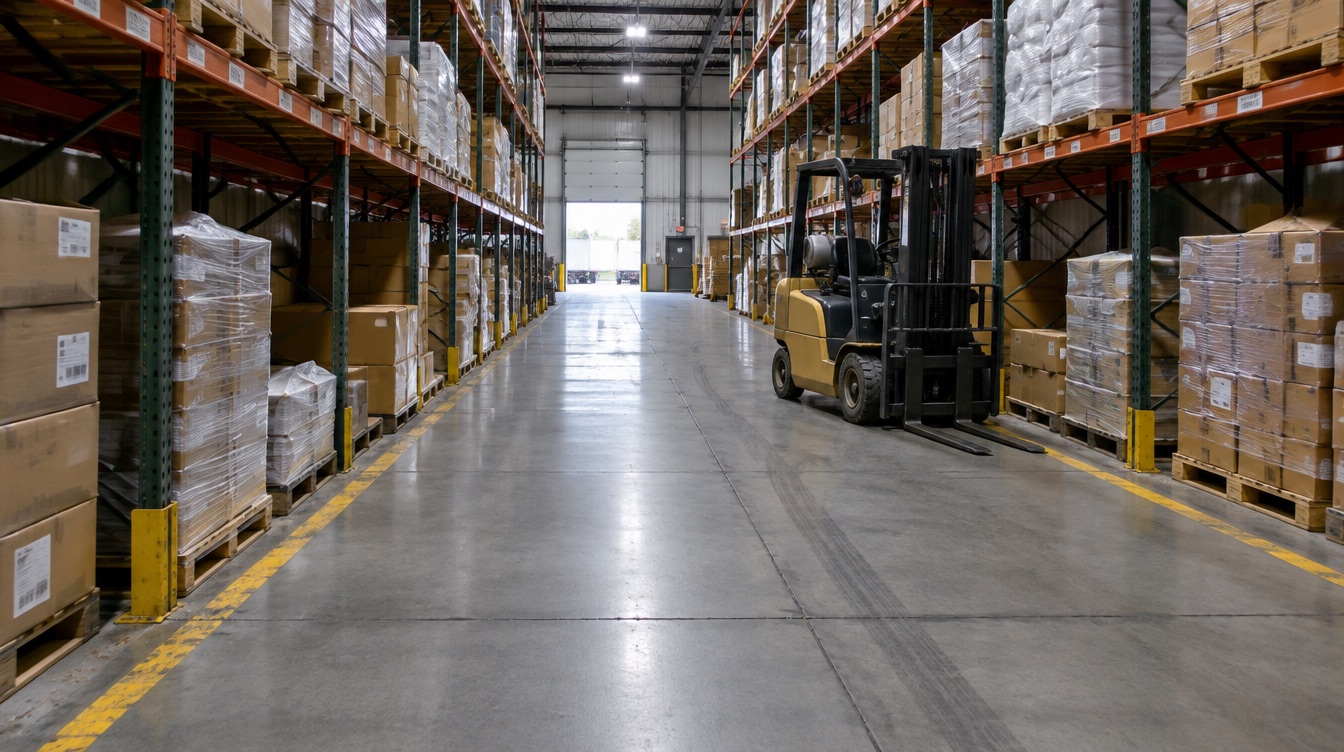
- Typical settings
- Manufacturing, processing, maintenance shops, battery and chemical storage rooms
- Common builds
- Novolac epoxy, epoxy mortar, urethane cement, broadcast quartz
- First question
- Which chemicals, at what temperature, for how long
Exposure drives the specification
| Exposure | Usually considered | Watch for |
|---|---|---|
| Acids, solvents, strong cleaners | Novolac epoxy topcoat or lining | Concentration and dwell time; check the chemical resistance chart for the exact product |
| Hot water, steam, thermal cycling | Urethane cement | Thickness, cove detail at walls and drains |
| Impact and steel wheels | Epoxy mortar or heavy broadcast build | Slab strength and repair of spalled joints first |
| Oil-soaked concrete | Cleaning, test patch, then system choice | Adhesion; oil wicks back up through thin coatings |
| General traffic and dust | Epoxy or urethane cement broadcast system | Slip texture and cleanability balance |
Product names and thicknesses are confirmed against the manufacturer data sheet for the exact exposure. A chemical chart that says "resistant" for splash is not the same as resistant for immersion.
Preparation and repair
Mechanical preparation
Diamond grinding or shot blasting to the concrete surface profile the system calls for, using the ICRI 310.2R profile scale. Acid etching is not an adequate preparation for industrial systems.
Dust control
Grinding concrete produces respirable silica. Work is planned around engineering controls such as shrouded tools and HEPA extraction, in line with OSHA’s respirable crystalline silica standard.
Joints and cracks
Control joints in forklift aisles are filled with a semi-rigid joint filler so wheels do not chip the edges. Moving joints are honored, not coated over.
Contaminated concrete
Oil and process residue are cleaned and tested with a small area before the whole floor is committed. A pull-off adhesion test (ASTM D7234) gives an objective answer.
Working around production
Industrial floors rarely get a clean, empty building. We plan sections, cure windows and odor control around shifts. The downtime guide separates coating stages from the real return of forklifts and chemicals. We also ask early about:
- Equipment that cannot move, and how much clearance it leaves.
- Ventilation and whether the building is occupied during installation.
- Minimum and maximum temperatures in the space, including weekends with heat turned down.
- Fire, safety and permit requirements of the facility.
Real questions people ask
What information do you need about chemicals?
We need the chemical name, concentration, temperature, spill frequency and dwell time. A product that survives a quick splash may not survive continuous contact.
Can you coat around equipment that cannot move?
Sometimes. We need working clearance for preparation equipment and a durable termination detail around every fixed base or penetration.
What happens to moving joints?
They are honored with an appropriate flexible detail. Coating straight across an active joint usually creates a predictable crack.
Related pages
Tell us about the floor
Describe the chemicals and traffic in the notes. Photos or a share link are optional; if available, joints, drains and damaged areas are the most useful views.