System
Polyaspartic floor coatings
Polyaspartic coatings cure fast and resist yellowing in sunlight. Those two traits make them useful for short closures and bright spaces, and they come with real installation trade-offs.
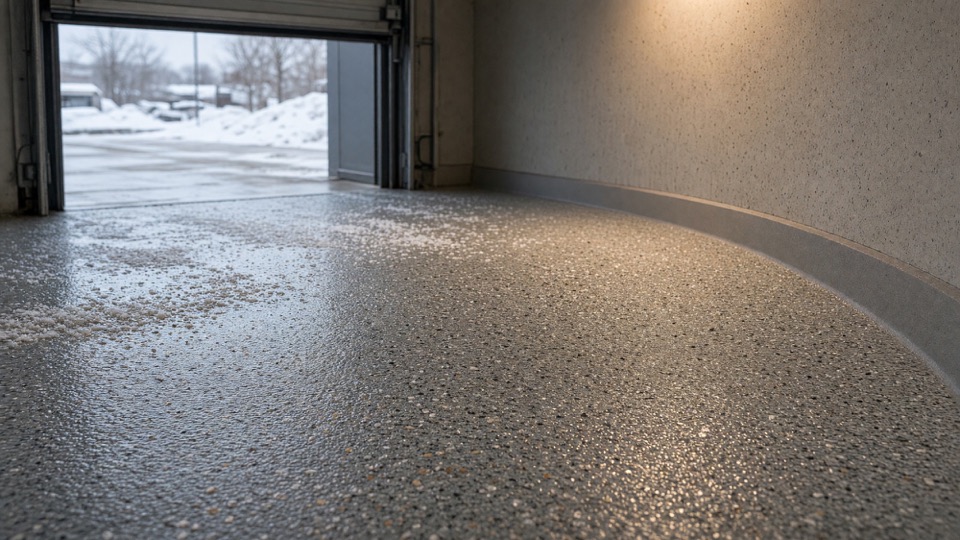
- Strength
- Fast cure, UV stability, wide installation temperature range
- Common use
- Topcoat over epoxy, or full flake systems
- Trade-off
- Short working time; preparation leaves no margin
Where it helps
Short closures
Many systems allow foot traffic within hours and vehicle traffic sooner than epoxy. Exact times depend on product and temperature, so use the downtime guide before promising a reopening time.
Daylight and storefronts
Aliphatic chemistry keeps color and gloss under UV, so floors near glass or open overhead doors do not amber like standard epoxy.
Cooler seasons
Many polyaspartics cure at lower temperatures than epoxy, which helps in unheated garages during shoulder seasons. Manufacturer minimums and dew point still apply.
The trade-offs
Fast cure means a short pot life. The crew has minutes, not hours, to place and finish material, which leaves little room for error on large areas. Depending on the product, polyaspartic coats may also be thinner than an epoxy body coat, so for heavy industrial traffic they are often used as the topcoat over an epoxy body coat rather than as the whole system.
Residential garages
Polyaspartic is popular for residential garages because it resists yellowing near the open door and can return to service faster than many epoxies. The right build still depends on the slab, moisture, old coatings and the amount of sunlight. See the residential flooring guide or choose "Residential garage" in the form.
Real questions people ask
Is polyaspartic always a one-day floor?
No. Fast cure helps, but preparation, repairs, moisture and job size still control the schedule. A rushed slab preparation produces a fast failure.
Does polyaspartic resist sunlight?
Aliphatic polyaspartic topcoats are UV stable and resist yellowing better than standard epoxy, which is useful near doors and windows.
Is it better than epoxy?
It is faster and more UV stable, but its short working time makes installation less forgiving. Many strong systems combine an epoxy build coat with a polyaspartic topcoat.
Related pages
Tell us about the floor
Tell us how long the space can close in the form. If the answer is "one night", polyaspartic may be part of the answer.